
Business process automation
The best automation does not start with a tool. It starts with a repeatable process, clear exceptions, good data and a metric that proves real work reduction.

Business process automation
The team manually retypes data between systems, spreadsheets, documents and messages.
Processes have many exceptions, but no one sees the full path, handling time and delay points.
Automation was already tested but ended as a fragile macro or ownerless tool.
There is no reliable data on how long the process really takes, where queues form and which exceptions consume the most time.
The team works across several tools, but the customer or manager only sees the delay, not the reason behind it.
The company wants to automate, but is not sure which steps should become rules, integrations, AI support and which must stay with a human.
Technology with a business reason
- We choose a process with high volume, clear input, measurable labor cost and limited first-deployment risk.
- We design workflows, validations, roles, task queues, integrations and exception handling before code is written.
- We combine classic automation with AI only where the model improves classification, document analysis or a working decision.
- We separate deterministic steps from places where classification, text analysis or AI-assisted decisions are actually useful.
- We design operational data so the process can be measured later: statuses, timings, errors, owners and delay sources.
- We build automation in small stages so the team can see impact quickly and safely adopt the new way of working.
What the scope can include
From first diagnosis to production growth. No unnecessary noise, with focus on results.
- 01 Process selection
- 02 Exception mapping
- 03 Workflow design
- 04 Automation build
- 05 Impact measurement
Production, not a demo
Automation works best when it removes a specific operating cost, has a process owner and reports outcomes: time, errors, volume and work removed from the team.
Related articles
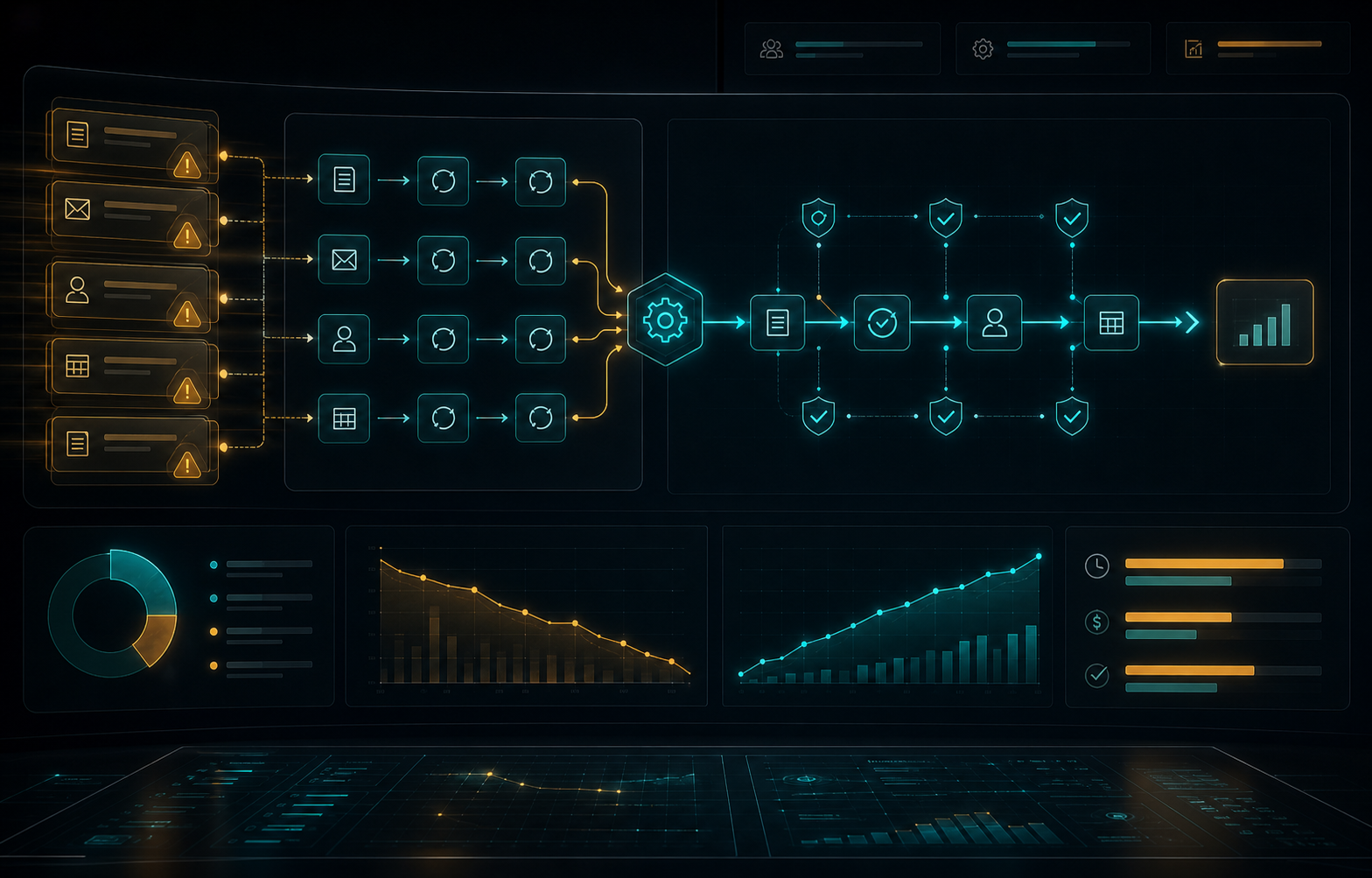 Automation · 7 min
Business process automation: how to find the first good use case
How to choose a process that brings quick impact and does not turn an automation pilot into an expensive experiment.
 Workflow · 8 min
AI workflow automation: how to connect models, people and systems into one controlled process
How to design workflows where AI accelerates work without taking uncontrolled responsibility.
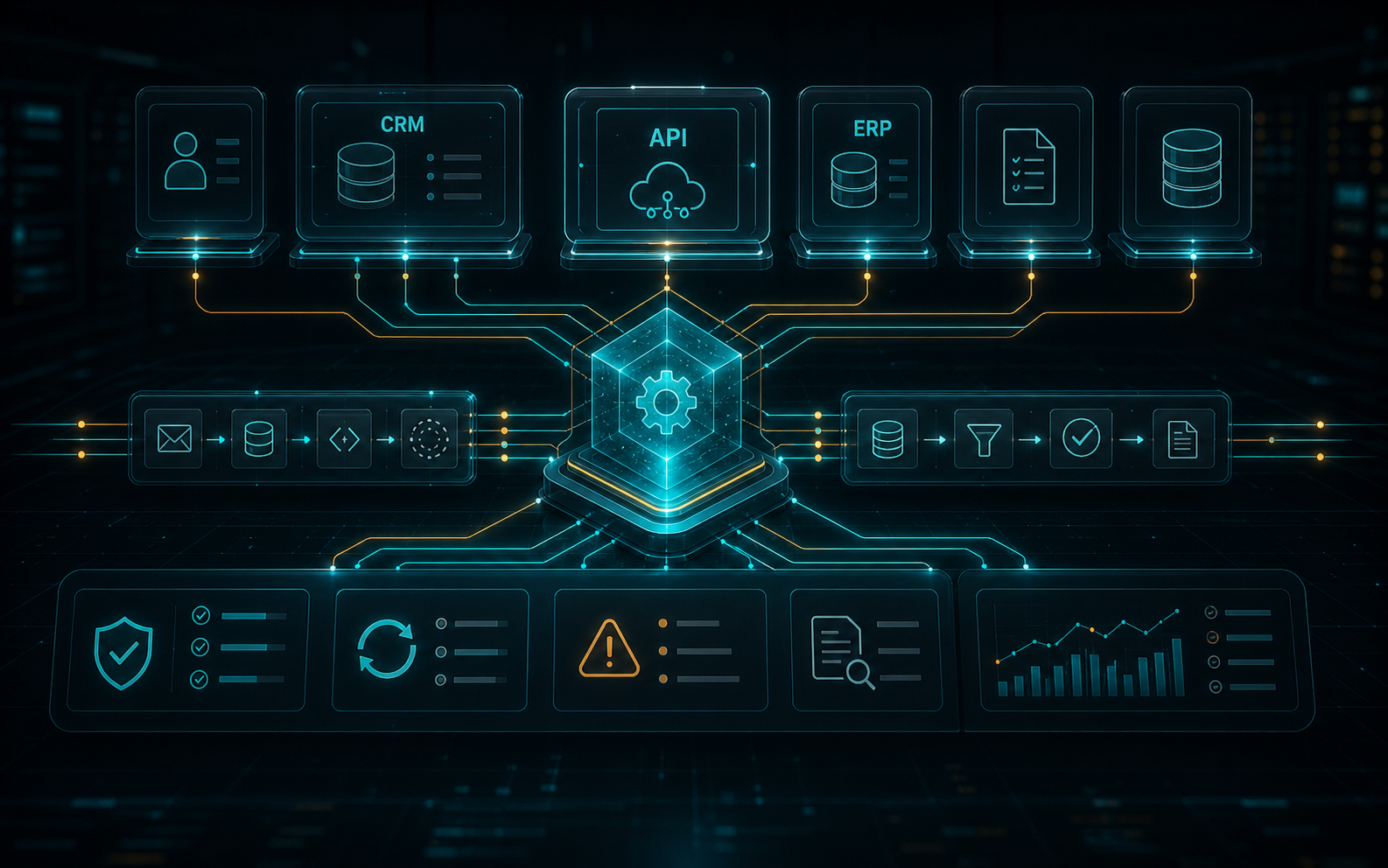 Integrations · 7 min
API, CRM and ERP integrations: how to connect systems without manual data retyping
How to design integrations that reduce errors, delays and dependence on manual work.
Frequently asked questions
Which process should be automated first?
One that is repeatable, has clear input data, many similar cases and a measurable manual work cost.
Does automation have to use AI?
No. AI makes sense for classification, content analysis and working decisions. Simple rules and integrations are often more stable.
What if the process has many exceptions?
We first describe exceptions, risk and escalation paths. Part of the process can be automatic while part requires human approval.
How do we measure automation impact?
We compare handling time, error count, number of manual steps, process cost, delays and team adoption.
Can only part of a process be automated?
Yes. A strong start is often input handling, validation, case routing, notifications or reporting without changing the whole process at once.
Can automation help if data lives in spreadsheets?
It can, but first we define which spreadsheets are sources of truth, who owns the data and how to avoid further manual copying.
How do we reduce the risk of hard-to-maintain automation?
We design process ownership, monitoring, logs, documentation, exception handling and clear rules for changing automation after launch.
Let us discuss this implementation
Describe the process, system or idea. We will return with a concrete first-step recommendation.